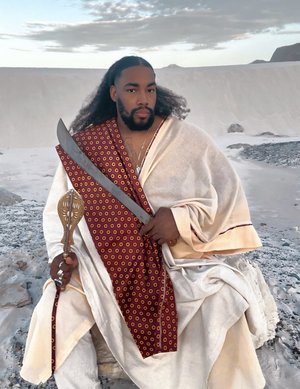
A Thousand Mouths: Purpose and Historical Importance
“A Thousand Mouths” is a mediumistic masquerade for the Drowned Ones of the Maafa. It restores voice where history enforced silence.
The Atlantic is a grave. During the Middle Passage, approximately 5 million Africans were thrown into its waters without funerary rites, without names preserved, without memorials. That rupture remains open. “A Thousand Mouths” addresses it directly.
The masquerade stands in continuity with ancestral technologies such as Egungun, Zaouli, Mmuo, and diasporan forms like Jonkanoo. In these systems, the dead are embodied. The Atlantic severed that continuity. This rite answers from within the logic of Hoodoo.
The title is literal and juridical. Every ancestor cast into the sea is a mouth. Every severed lineage is a mouth. Every suppressed testimony is a mouth. The body becomes a chorus.
It is danced twice yearly in February and October, so that remembrance remains disciplined and fixed in time.
This establishes an Atlantic-facing canon within Hoodoo. The Drowned Ones are placed back into liturgical time. Remembrance moves.
The Theophany of the Drowned Ones is the moment the ocean ceases to be metaphor and becomes Presence. In “A Thousand Mouths,” what history attempted to sink stands upright in air. The sea speaks inland. The nameless become articulate. This is not recollection. It is arrival.
Five million thrown into the Atlantic is not only a statistic; it is an unfinished spiritual event. Ships were logged. Cargo was counted. The dead were not consecrated. A civilization was constructed atop an unperformed funeral.
“A Thousand Mouths” completes what was denied. Without ritual, rupture distorts. With ritual, it becomes lineage, instruction, and force.
It is necessary for sovereignty. A people who cannot ritually account for their dead remain tethered to the narrative of their captors. When the Drowned return through the body, the story shifts. They are no longer casualties of the Atlantic; they are presences within it.
I bear it forth because the current runs through me. The Kalunga is not metaphor in my cosmology; it is threshold and archive. The Myriad is built on ancestral jurisprudence. We address fractures with structure.
The Maafa is not a topic. It is a breach in the spiritual architecture of the Diaspora. I correct breaches.
The Myriad carries water as law. We are initiatory and built for continuity. “A Thousand Mouths” is not an event; it is a canon in formation.
I am already positioned at the shoreline historically, spiritually, andintellectually. I have the House and the framework to fix this rite into time and keep it there.
The Drowned did not need pity. They required articulation.
I have given them A Thousand Mouths.