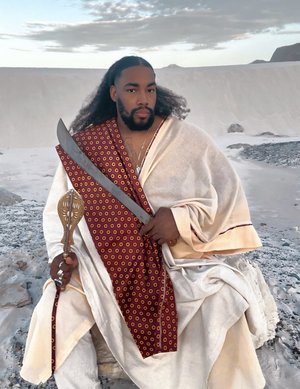
The Myriad: An intervention within Hoodoo
To understand The Myriad as an intervention within Hoodoo, one must first understand the conditions into which it emerged. Hoodoo today exists in a profoundly contradictory position. It is one of the most culturally influential Black spiritual traditions on Earth, with fingerprints all over music, language, aesthetics, religion, folklore, performance, healing traditions, and popular culture and yet it is routinely spoken about as though it possesses no internal sophistication, no metaphysics, no governing logic, no jurisprudence, no theology, no architecture of thought beyond isolated acts of spellwork and folk practice.
I reject this framing entirely. Because without those things, not only could we not work, but the work would be impossible
The Myriad emerged because I fundamentally do not believe Hoodoo is merely a loose collection of techniques held together by historical memory. Our traditions are not residue. I believe it is a civilization-bearing spiritual complex whose full scale has been suppressed, fragmented, or rendered illegible by colonialism, anti-Blackness, forced Christianization, economic precarity, and the survival conditions imposed upon Black people across centuries.
The intervention, then, is not simply organizational. It is ontological.
The Myriad asserts that Hoodoo possesses the capacity for institutional continuity, cosmology, governance, aesthetics, archival infrastructure, rites of passage, diplomacy, metaphysics, and future-oriented expansion. All as expressions emerging organically from the internal logic of the tradition itself.
One of the great crises affecting modern Hoodoo discourse is that many people can only imagine Black spirituality in conditions of fragmentation. The moment structure appears, people become suspicious. The moment philosophical language emerges, people accuse you of fabrication. The moment beauty, regalia, ceremony, hierarchy, architecture, or institutional ambition enters the picture, people begin attempting to collapse the tradition back into something smaller and more “manageable.”
This reaction is not accidental.
The West trained people to imagine Black sacred traditions as permanently informal. Perhaps spiritually potent, but not fully civilizational. Useful for survival, but not governance. Emotionally resonant, but not philosophically rigorous. Capable of ritual, but not jurisprudence. Capable of folklore, but not futurity. Dangerous. Primitive.
The Myriad intervenes directly against those limitations. Before we crossed the sea, our traditions were held within cultural institutions. We of The Myriad continue this precedent.
I am not interested in presenting Hoodoo merely as a set of reactive survival behaviors born under slavery. While survival is central to our history, no people can remain eternally trapped within the posture of emergency. A tradition must eventually ask itself what it means to endure beyond survival. What institutions emerge? What archives are preserved? What songs are carried forward? What laws govern relations between houses, lineages, spirits, elders, and initiates? What aesthetic language communicates sovereignty? How are disputes adjudicated? What constitutes inheritance? What obligations exist to the dead, to the unborn, and to the land itself?
These are civilizational questions.
The Myriad is therefore an intervention withiHoodoo back toward its full scale. We refuse the modern pressure to deny the depth that has always been there.
This is why I speak openly about cosmology, about the Dikenga, about pantheons, about spiritual law, about ritual architecture, about ancestor reverence, about ceremonial offices, about archives, about hymns, about regalia, about institutional continuity, about sound as technology, and about the future. Not because I believe Black traditions must imitate empires in order to matter, but because I reject the lie that Black traditions were ever inherently small.
The Myriad is also an intervention into temporality itself.
Too much discourse around Hoodoo speaks as though Black sacredness only exists in the past tense — as preservation, residue, memory, inheritance. What we did, and locating authenticity in imitating a past we did not live or suffer in. That past is our substrate. But I am equally interested in Hoodoo’s future tense. What does Hoodoo look like in 50 years? In 200 years? What happens when Black spiritual traditions begin developing archives, institutes, cultural centers, formal rites of passage, international influence, published canons, and enduring intergenerational structures? What happens when Hoodoo stops apologizing for existing and instead begins articulating itself as a governing metaphysical framework?
This is where Afrofuturism becomes important.
Because the question is not simply whether Black people survived history. The question is whether Black people are imagined as possessing legitimate claim over the future itself. Over the stars. Over advanced technology. Over law. Over philosophy. Over beauty. Over governance. Over the sacred architecture of worlds yet to come.
The Myriad insists that we do.
And perhaps this is what unsettles some people most. Not merely that Hoodoo survives, but that someone would dare to imagine it as sovereign, expansive, elegant, intellectual, beautiful, juridical, and enduring.
But I believe this discomfort reveals the exact limitation that must be overcome.
Because a people whose culture and spirituality shaped continents should not speak of themselves as though they are destined only for fragments.