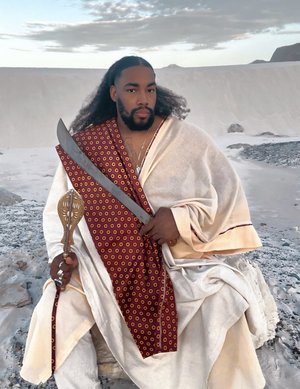
Beauty, Elegance, and the Black Sacred Masculine
One of the great violences of colonial modernity was not merely the material domination of Black people, but the systematic narrowing of how Blackness itself could be perceived. Black men in particular were rendered legible through a series of restrictive archetypes: the brute, the laborer, the criminal, the hypersexual primitive, the comic figure, the disposable body, the endlessly hard body incapable of refinement, softness, ceremonial presence, or metaphysical authority.
And because modernity repeats itself psychologically long after formal colonialism ends, many people remain deeply uncomfortable when Black masculinity appears elegant, aristocratic, spiritually authoritative, beautiful, luxurious, disciplined, or ceremonially severe.
Especially within sacred contexts.
People can tolerate Black masculinity as entertainment.
They can tolerate it as athleticism.
They can tolerate it as rebellion.
They can tolerate it as suffering.
But beauty unsettles them.
Elegance unsettles them.
Sacred authority unsettles them.
Because elegance implies civilization.
Ceremony implies continuity.
Adornment implies sovereignty.
And sovereignty has historically been imagined as belonging elsewhere.
This is part of why the Black sacred masculine has so often been flattened either into hypermasculine aggression or stripped-down utilitarian survival. The possibility that a Black man may be spiritually powerful while also beautiful, poised, adorned, intellectually rigorous, emotionally controlled, aesthetically refined, and ceremonially elevated destabilizes the racial imagination inherited from modernity.
Particularly because beauty itself has been racialized.
European civilization consistently positioned itself as the natural home of refinement, aristocracy, monumental beauty, sacred architecture, and juridical authority, while Blackness was pushed into the symbolic territory of the raw, the excessive, the bodily, the improvised, and the perpetually “earthbound.” Even admiration for Black aesthetics was often filtered through primitivism rather than sophistication.
Thus when a Black spiritual authority appears with elegance, regalia, disciplined symbolism, ceremony, formal posture, or aristocratic aesthetics, many people instinctively attempt to reduce it to performance, ego, delusion, narcissism, or theatricality.
But this reaction reveals more about the observer than the figure being observed.
Because every civilization on Earth uses aesthetics to communicate metaphysical seriousness.
Crowns are not accidental.
Robes are not accidental.
Ceremonial jewelry is not accidental.
Sacred music is not accidental.
Processions are not accidental.
Perfume, fabrics, architecture, posture, gesture, ornamentation, and visual discipline are not superficial additions to sacred systems. They are part of how civilizations materialize meaning.
Power has always understood this.
A cathedral teaches before a priest ever speaks.
A palace communicates authority before law is uttered.
A shrine shapes perception before prayer begins.
And Black people understood this too.
One of the great lies imposed upon us is that our traditions were inherently aesthetically minimal or anti-monumental. In reality, African civilizations possessed extraordinary ceremonial systems, court cultures, sacred regalia traditions, philosophical schools, architectural achievements, metallurgical mastery, textile traditions, and ritual infrastructures long before colonial disruption.
The Black sacred masculine did not begin as degradation.
It was degraded.
This distinction matters immensely.
Because many people have unconsciously become attached to images of Black spirituality that remain visibly marked by oppression. The exhausted worker. The hidden practitioner. The poor preacher. The fragmented remnant. The survivalist figure. These realities are historically true, but they emerged under violent conditions. They are not necessarily the highest imaginable expression of Black sacred life.
A people surviving captivity should not become permanently aesthetically trapped within the visual language of captivity.
And this is where elegance becomes politically dangerous.
An elegant Black spiritual figure refuses the colonial demand that Blackness remain visually subordinate.
A beautiful Black man with ceremonial authority refuses reduction into mere physicality.
Adornment refuses invisibility.
Luxury refuses the mythology of Black unworthiness.
Poise refuses chaos.
Discipline refuses caricature.
Sacred beauty refuses degradation.
This is also why Black men who occupy spaces of beauty and authority often provoke unusually intense projection. Some perceive arrogance where there is merely self-possession. Others perceive theatricality where there is ceremonial intentionality. Others become obsessed with “humility,” as though Black sacred authority must always apologize for itself in order to remain acceptable.
But no civilization asks this of its sacred figures.
No one demands cathedrals become ugly in order to prove sincerity.
No one demands kings strip themselves bare to prove legitimacy.
No one demands ritual objects become crude to prove authenticity.
Yet Black sacredness is constantly pressured toward aesthetic smallness.
I reject that pressure entirely.
I believe beauty is part of metaphysical order.
I believe elegance can itself become ceremonial.
I believe the sacred deserves adornment.
I believe disciplined aesthetics shape consciousness.
I believe grandeur communicates continuity.
I believe Black spirituality possesses every right to appear monumental, refined, luxurious, intellectual, beautiful, juridical, and future-facing.
And perhaps this is what truly unsettles people.
Not merely that Black spirituality survives.
But that it may once again begin presenting itself as sovereign.